
Good time management at O and A Level isn’t about squeezing in more hours. It’s about a handful of specific habits that make the hours already available actually count. This guide breaks down the time management habits that consistently separate students who feel in control of their revision from those who feel like they’re constantly playing catch-up and how the right structure, like the one built into Abeel Eschool of O and A Level‘s program, makes several of these habits far easier to actually maintain.
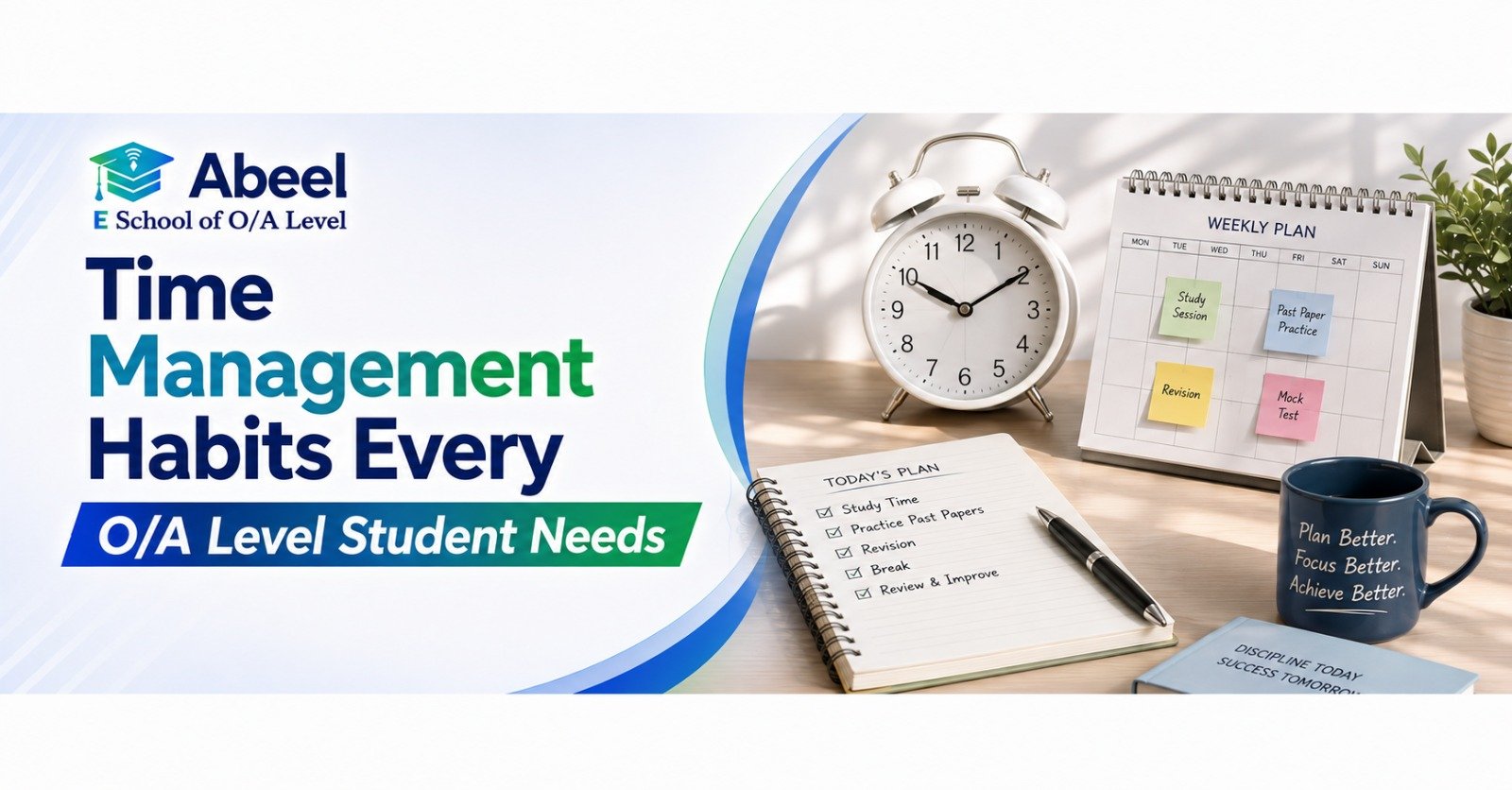
Habit 1: Build a Weekly Schedule, Not Just a Daily To-Do List
A daily to-do list feels productive in the moment but rarely accounts for the bigger picture which subjects are falling behind, which exam is coming up soonest, or whether revision time is actually balanced across everything that needs covering. A weekly schedule solves this by giving a student a wider view: a clear sense of how each subject is being covered across the week, not just what feels urgent today.
The most effective weekly schedules start with the fixed, non-negotiable items first school hours, sleep, meals, any commitments and then fill in study blocks around them, rather than the reverse. This avoids the common trap of scheduling revision optimistically and then having no realistic space left for it once the week actually happens.
Habit 2: Study in Focused Blocks, Not Marathon Sessions
Long, unbroken study sessions feel disciplined, but concentration and retention both decline sharply after 45 to 60 minutes of focused work. Students who study in structured blocks roughly 45–60 minutes of focused work followed by a genuine 10–15 minute break consistently retain more than those who push through hours at a stretch without pausing.
This isn’t about studying less; it’s about studying in a way that the brain can actually absorb. A student doing four properly-spaced 50-minute blocks across an evening will typically retain more than one doing three unbroken hours back to back.
Habit 3: Prioritize by Weakness and Exam Weightage, Not Comfort
One of the most common (and least talked about) time management mistakes is spending disproportionate time on subjects or topics a student already finds comfortable, simply because it feels productive and low-stress while genuinely weak areas keep getting pushed to “later.”
A better approach: identify weak topics honestly, and allocate more time to them specifically, alongside topics that carry heavier weightage in the actual exam paper. This requires an honest, ongoing sense of where a student actually stands which is often harder to self-assess accurately than it sounds. This is exactly the gap a smart tracking system is built to close. At Abeel Eschool of O and A Level, the smart course completion system tracks progress topic by topic and flags weak areas automatically, so time gets allocated based on real data rather than a student’s gut feeling about what “seems” weak.
Habit 4: Start Past Papers Early- Not in the Final Weeks
A huge number of students save past papers for the final month before exams, treating them as a last test rather than an ongoing learning tool. This backfires in two ways: it delays the discovery of technique gaps until there’s little time left to fix them, and it turns past paper practice into a source of last-minute panic rather than steady, confidence-building repetition.
Past papers work best woven into weekly revision from early in the course a couple of hours a week initially, increasing as exams approach reviewed properly against the mark scheme each time, not just completed and set aside.
Habit 5: Protect a Fixed Weekly Revision Slot – And Treat It as Non-Negotiable
This is one habit that’s easy to state and surprisingly hard to maintain without external structure. A revision slot that exists only “when there’s time” tends to quietly disappear during busy weeks exactly when consistent revision matters most.
This is one of the specific reasons Abeel Eschool of O and A Level built its program around weekly live revision sessions rather than optional, on-demand content. A scheduled, tutor-led session every week creates a fixed point in a student’s calendar that’s much harder to skip than a self-directed revision slot competing against every other demand on their time and it comes with the added benefit of a tutor actively working through past papers and exam technique in real time, rather than a student attempting the same self-review alone.
Habit 6: Don’t Wait for the Next Class to Fix a Misunderstanding
Time management isn’t only about scheduling it’s also about not wasting the time that’s already been spent. A student who studies a topic, half-understands it, and moves on without correction often ends up needing to revisit that same topic again later, effectively doubling the time cost of a misunderstanding that could have been resolved immediately.
Direct, responsive tutor support prevents this kind of wasted repetition. Rather than waiting days for the next scheduled class to ask a question, students at Abeel Eschool of O and A Level can reach their subject tutor directly when a doubt comes up closing the gap before it costs additional revision time later.
Habit 7: Use a Study Environment That Actually Works
Time spent “studying” in a distracting environment phone notifications, background noise, an uncomfortable or cluttered space often produces far less learning per hour than the same time spent in a quiet, organized space. A consistent, dedicated study spot, even a small one, signals to the brain that it’s time to focus, and reduces the friction of getting started each session.
Habit 8: Build In Real Breaks – Not Just Screen Time
Breaks between study blocks matter, but not all breaks are equal. Scrolling on a phone during a “break” often leaves a student more mentally scattered afterward, not refreshed. A short walk, stretching, or simply stepping away from screens tends to restore focus far more effectively before returning to the next study block.
Habit 9: Review the Week, Not Just the Day
At the end of each week, a short review what got covered, what didn’t, which topics still feel shaky helps a student adjust the coming week’s plan realistically, rather than carrying forward a vague sense of “being behind” without knowing exactly where. This weekly checkpoint is often what separates students who steadily close gaps over the course of a term from those who discover the same gaps all at once, right before exams.
Habit 10: Don’t Try to Manage It All Alone
Perhaps the most important time management habit isn’t a scheduling technique at all it’s recognizing that consistent, well-managed revision is genuinely difficult to sustain entirely independently over months, especially alongside school, family, and everything else competing for a student’s attention. Structured external support a study plan built around actual exam dates, regular tutor check-ins, and a system that tracks whether a plan is actually being followed — takes a significant amount of the time management burden off the student directly.
This is the core idea behind how Abeel Eschool of O and A Level approaches revision. Rather than handing a student a generic calendar and leaving them to manage it independently, the program combines a customized, subject-by-subject study plan with weekly live revision sessions and direct tutor support effectively building several of the habits above directly into the structure of the program itself, rather than relying on a student to build and maintain them entirely on their own. At the time of writing, Abeel Eschool of O and A Level is the only institute offering this exact combination weekly live revision, direct tutor support, and smart course completion tracking as a standard part of its program.
Frequently Asked Questions
How many hours should O Level or A Level students study daily?
This varies by student and time of year, but a general guide is 2–4 focused hours daily during the regular term, increasing to 5–6 hours as exams approach always broken into focused blocks with proper breaks rather than long unbroken sessions.
What’s the biggest time management mistake O/A Level students make?
Spending disproportionate time on comfortable, already-strong topics while avoiding genuinely weak areas, simply because reviewing weak topics feels less immediately productive. Honest, tracked progress like the system used at Abeel Eschool of O and A Level helps correct this.
Should I start past papers early, or closer to exams?
Early ideally woven into weekly revision from well before the final exam period, not saved for a last-minute cramming push. Reviewing each paper against the mark scheme is just as important as completing it.
How long should a single study session be?
Around 45–60 minutes of focused work, followed by a genuine 10–15 minute break, tends to produce better retention than longer, unbroken sessions.
How does tutor support actually improve time management?
By preventing wasted repetition. A misunderstanding caught and corrected immediately, through direct tutor support like that offered at Abeel Eschool of O and A Level, saves the additional time a student would otherwise spend re-learning the same topic later.
What makes Abeel Eschool of O and A Level different when it comes to time management specifically?
Abeel Eschool of O and A Level is currently the only institute offering weekly live revision sessions, direct tutor support, and smart course completion tracking together as standard effectively building structure and accountability into a student’s schedule rather than leaving time management entirely up to them.
How do I get started with Abeel Eschool of O and A Level?
You can reach out through the Abeel Eschool of O and A Level admissions page to get a personalized study plan built around your actual subjects and exam dates.
For further guidance on structured revision timetables and study techniques, School of Cambridge offers a detailed, practical breakdown worth reading alongside this guide.
Have a question about this topic?
Send your query to Abeel Eschool and our admissions team will get back to you.