
Walk into almost any O Level or A Level student’s room during exam season and you’ll find the same thing: a stack of downloaded past papers, half of them untouched, the other half filled in without ever being marked. Past papers are, without question, the single most effective revision tool for Cambridge exams but at Abeel Eschool of O and A Levels, we see the same mistakes repeated year after year, and they quietly cost students grades they could easily have secured.
This guide breaks down how Cambridge past papers should actually be used not just downloaded and covers a related question many parents ask separately: whether their child should take Additional Mathematics (0606) alongside regular Maths.
Why Past Papers Work (When Used Correctly)
Cambridge International past papers aren’t practice questions written to resemble the real exam they are the real exam, from previous series. That means the phrasing, structure, mark allocation, and question style are identical to what your child will face in the actual paper. No revision guide or textbook exercise replicates that authenticity.
But here’s the part most students skip: past papers are only useful when paired with the official mark scheme and, ideally, the examiner report for that series. Without those two documents, a completed past paper is just a guess with no feedback loop. At Abeel Eschool of O and A Levels, we treat the mark scheme as equally important as the paper itself because it tells students exactly how examiners award (and deduct) marks, which is often very different from how students assume answers are graded.
The Most Common Mistakes Students Make
Doing Papers Untimed Until the Last Month
Many students spend months working through past papers with no timer running, telling themselves they’ll “add pressure later.” The problem is that time management is a skill being tested particularly in subjects like Mathematics, Sciences, and English, where students routinely lose marks not because they don’t know the content, but because they run out of time on the final section. Timed practice should start early, not just in the final weeks before exams.
Marking Leniently – or Not Marking at All
This is the biggest one. Students often glance at their answer, decide it’s “basically right,” and move on without ever opening the mark scheme properly. Cambridge mark schemes are specific about method marks, own-figure-rule allowances, and exact wording expectations especially in Mathematics, Economics, and the Sciences. Marking your own paper honestly, line by line, against the official scheme is where the real learning happens. Tutors at Abeel Eschool of O and A Levels insist on this step precisely because self-graded shortcuts are where students overestimate their readiness.
Ignoring the Examiner Report
Examiner reports are, frankly, underused by almost every student we meet. These reports published by Cambridge alongside the mark scheme explain exactly where candidates lost marks that year, what common misconceptions examiners noticed, and how top-scoring answers were structured. Reading the examiner report after marking a paper often reveals why a student is losing marks, not just that they are.
Practising the Wrong Syllabus Year
Cambridge syllabuses are updated periodically, and using papers from a syllabus version that’s several years outdated can mean practising content or question formats that no longer appear in the current exam. Always confirm the current syllabus code and version before working through a batch of papers a detail that’s easy to overlook when downloading papers in bulk from unofficial sources.
Treating Past Papers as a Memorization Exercise
Some students work through the same five past papers repeatedly, effectively memorizing answers rather than understanding the underlying concept. When the actual exam presents a slightly reworded version of a familiar question, they freeze. Past papers should build understanding transferable to any version of a question not just recall of one specific answer.
Cramming Papers Back-to-Back Without Review
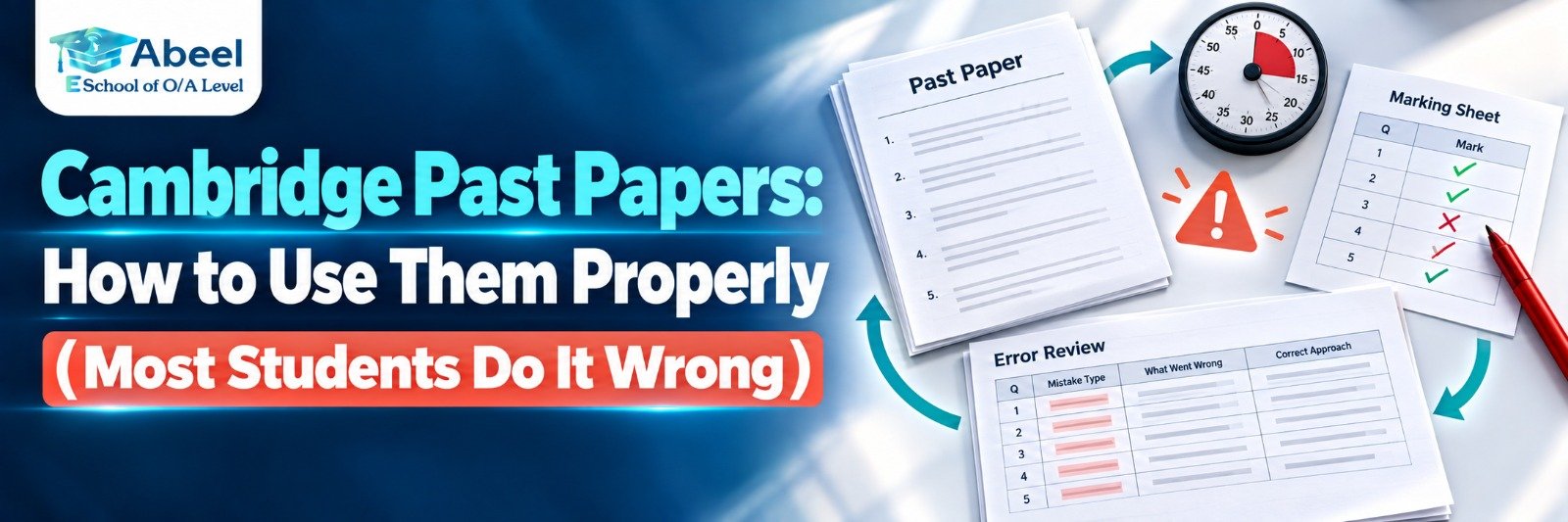
Doing paper after paper without pausing to review mistakes is busy work, not revision. A better approach the one we use at Abeel Eschool of O and A Levels is to complete one paper, mark it thoroughly, identify the one or two weakest topics it revealed, revise those specifically, and only then move to the next paper. This cycle is slower but dramatically more effective than volume-based cramming.
The Right Way to Use Cambridge Past Papers: A Five-Step Cycle
- Confirm the syllabus code and paper number before starting, to ensure relevance to the current exam.
- Sit the paper under timed, exam-like conditions no notes, no phone, strict time limits.
- Mark it honestly using the official Cambridge mark scheme, applying method marks and own-figure-rule exactly as examiners would.
- Read the examiner report for that series to understand common mistakes and what strong answers looked like.
- Drill the one or two weakest topics the paper revealed before attempting the next full paper.
This cycle, repeated consistently over several months rather than crammed into a few final weeks, is what actually moves grades not the sheer number of papers attempted. Official past papers, mark schemes, and examiner reports are available directly through Cambridge Assessment International Education’s official past papers portal, which should always be the primary source over unofficial compilations of uncertain accuracy.
Add Maths (0606) vs. Regular Maths: Should Your Child Take Both?
This question comes up almost as often as past paper strategy, and the two are more connected than most families realize because a student’s exposure to calculus and advanced algebra through Add Maths directly changes how they approach past papers at the A Level stage.
Regular O Level / IGCSE Mathematics (Cambridge 4024/0580) covers the core syllabus: algebra, geometry, mensuration, basic trigonometry, and statistics. It’s compulsory for nearly all students and forms the baseline numeracy expected before A Level study.
Additional Mathematics (0606) goes considerably further introducing calculus, advanced trigonometric identities, functions, and more complex algebraic techniques. Crucially, it’s meant to be taken alongside regular Maths, not instead of it, and its content overlaps significantly with the first year of A Level Mathematics.
Should your child take both?
- If they’re heading toward A Level Physics, Further Mathematics, Engineering, or a quantitative Business/Economics path, Add Maths gives a genuine head start. Students who’ve already worked through calculus-based past papers at O Level tend to handle A Level Maths past papers with far less friction in the first term.
- If they’re on a Biology/Chemistry-focused Medicine pathway without A Level Maths or Physics, Add Maths is optional rather than essential.
- If regular Maths is already a struggle, adding Add Maths on top usually backfires it assumes strong core fluency first, and without that foundation, past paper practice in Add Maths becomes frustrating rather than productive.
At Abeel Eschool of O and A Levels, we assess each student’s Mathematics foundation individually before recommending Add Maths because the subject only helps when a student is genuinely ready to build on it, not just add another qualification to their transcript. For the official syllabus content, Cambridge’s Additional Mathematics (0606) syllabus page is the most reliable outbound reference for parents comparing the two options.
How Abeel Eschool of O and A Levels Structures Past Paper Practice
Rather than handing students a folder of past papers and leaving them to self-study, Abeel Eschool of O and A Levels builds past paper practice into a structured revision timeline starting three to four months before exams, not the final few weeks. Each student’s weak topics, identified through marked papers, feed directly into targeted tutoring sessions, so revision time is spent on what actually needs fixing rather than repeating what a student already knows.
This is the difference between past papers as a checklist item and past papers as an actual diagnostic tool and it’s usually the single biggest factor separating students who improve steadily from those who plateau despite doing “a lot of practice.”
Frequently Asked Questions
How many past papers should my child do before an exam?
There’s no fixed number quality matters more than quantity. A student who does 15 papers properly marked and reviewed will outperform one who rushes through 40 without checking mark schemes.
When should past paper practice start?
Ideally three to four months before the exam, once core topics have been taught. Starting only in the final weeks limits how much can genuinely be improved.
Are mark schemes really necessary, or can students just check answers themselves?
Mark schemes are essential. They show exactly how method marks, own-figure-rule, and partial credit are awarded details students consistently misjudge when self-marking without them.
Where can I find official Cambridge past papers?
The official source is the Cambridge Assessment International Education past papers portal, which should always be prioritized over unofficial or outdated compilations.
Is Add Maths (0606) necessary for A Level Mathematics?
Not strictly necessary, but strongly recommended for students planning A Level Maths, Further Maths, Physics, or Engineering, since it covers content that overlaps with early A Level topics.
Does Abeel Eschool of O and A Levels provide guided past paper practice?
Yes, tutors structure past paper practice into each student’s revision plan, using marked results to identify and target weak topics rather than leaving practice unstructured.
Can past papers alone guarantee a good grade?
No single resource guarantees a grade, but structured, properly marked past paper practice combined with solid topic understanding is consistently one of the strongest predictors of exam performance.
If your child’s exam preparation feels more like guesswork than strategy, the tutors at Abeel Eschool of O and A Levels can build a structured past paper and revision plan tailored to their specific subjects and weak areas.
Want this published as a live page on your site, or saved as a Word document for your team to review first?
Have a question about this topic?
Send your query to Abeel Eschool and our admissions team will get back to you.
2 Responses