Results day comes and goes, and then a strange thing happens: all the pressure that built up for two years suddenly has nowhere to go. Parents and students who spent months laser-focused on exams often find themselves standing at a fork in the road with surprisingly little clarity on what comes next. “Now what?” is one of the most common questions we hear right after “how did I do?” and it deserves a far more complete answer than most guides give.
This post walks through exactly what happens after O Level and after A Level in Pakistan the university pathways, the local versus international decision, career-linked subject requirements, and the less-talked-about options like gap years and early work experience. And because the path after A Level in particular is shaped heavily by decisions made during O and A Level, we’ll also look at how the right academic support the kind provided at Abeel Eschool of O and A Level sets a student up properly for whichever direction they choose.
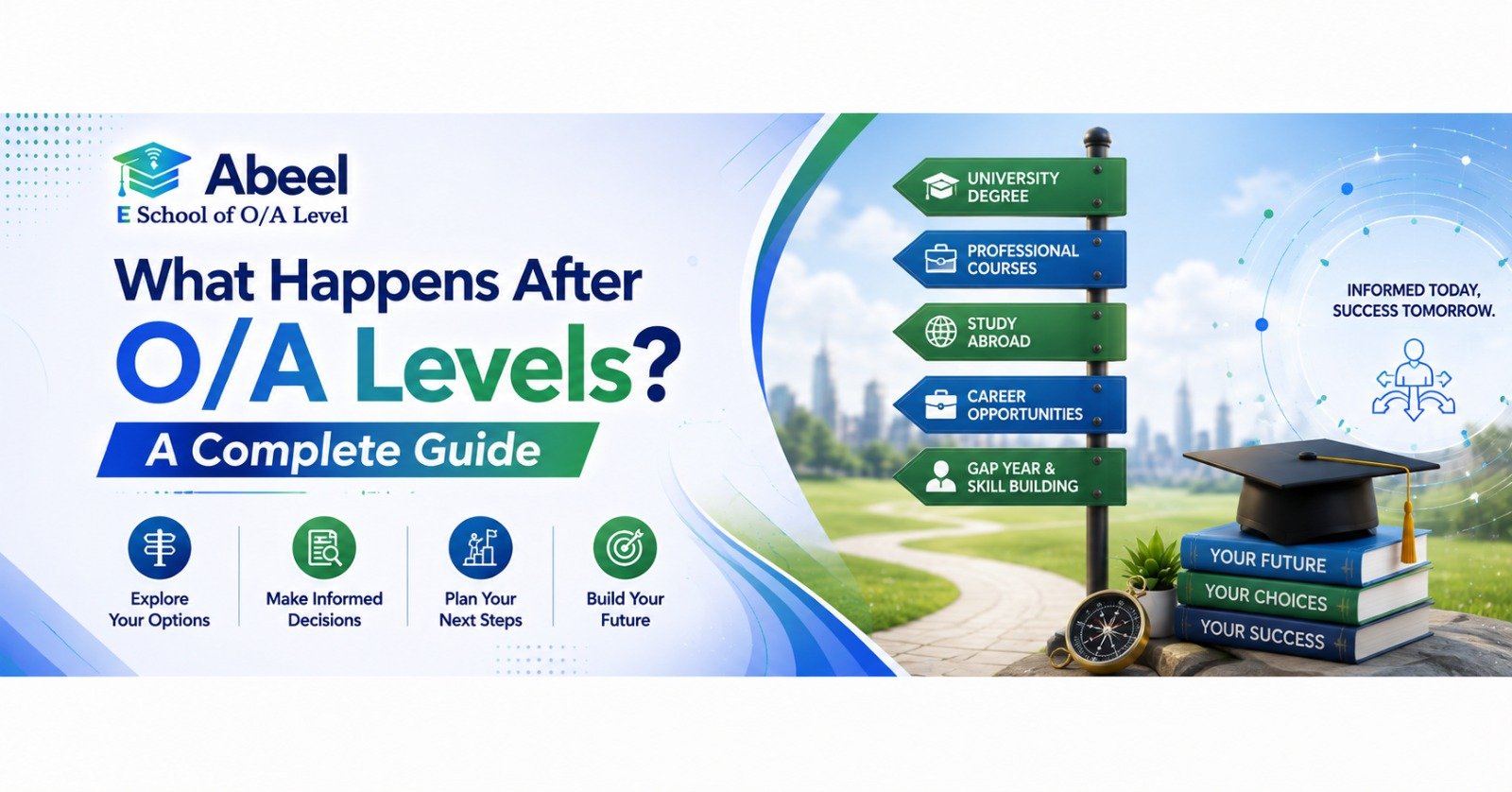
After O Level: The Natural Next Step Is A Level, But Not the Only One
For the vast majority of O Level students in Pakistan, A Level is the natural continuation same Cambridge-aligned system, same style of assessment, and a smoother academic transition than switching systems entirely. A Level lets a student specialize in three or four subjects, building directly toward university admissions in Pakistan or abroad.
That said, it isn’t the only route. Some students switch to Matriculation-to-Intermediate pathways (FSc, ICS, FA, ICom) after O Level, particularly if cost is a major factor or if a student is targeting Pakistan-specific entry tests like MDCAT or ECAT that align closely with the local Intermediate syllabus. Switching is possible but requires attention to subject compatibility and equivalence — it’s a decision worth making early rather than mid-way through, since retroactively correcting a subject mismatch can cost time.
This is exactly why subject counselling at the O Level stage matters as much as counselling later at A Level. At Abeel Eschool of O and A Level, this guidance is built into the program from the start, so students aren’t choosing O Level subjects in isolation without a sense of where those choices actually lead.
After A Level: The Big Fork- Local University, Foreign University, or Something Else
This is where most of the real decision-making happens, and it’s worth breaking down properly rather than treating it as a single binary choice.
Option 1: University in Pakistan
A Level graduates are well-positioned for Pakistan’s top universities – institutions like LUMS, IBA, NED, Habib University, and Aga Khan University are among the most commonly targeted destinations for A Level students staying local. Because A Level is internationally recognized and academically rigorous, local top-tier universities generally welcome A Level applicants readily, often alongside students coming from FSc/Intermediate backgrounds.
For fields like medicine and engineering, students typically still need to sit Pakistan’s entry tests MDCAT for medical programs and ECAT for engineering meaning A Level subject choices (particularly Biology, Chemistry, Physics, and Mathematics) need to align with those requirements well in advance, not decided last-minute in the final year.
Option 2: University Abroad
For students pursuing international admissions UK, US, Canada, Australia the process is more demanding and needs to start well before final A Level results are released. UK applications, for instance, are typically made through UCAS based on predicted grades submitted by the school or institute, meaning consistent performance across both A Level years matters just as much as final exam results.
The reality for many Pakistani families is that logistics and cost genuinely factor into this decision students from smaller cities in particular often weigh local top-tier universities against the cost and distance of studying abroad. Scholarships and financial aid can meaningfully shift that calculation, which is why it’s worth researching funding options early rather than assuming international study is out of reach by default.
Option 3: Professional Certifications and Specialized Routes
A Level graduates aren’t limited strictly to a traditional bachelor’s degree pathway. Depending on subject background, direct routes exist into:
- ACCA or CA for students with strong Accounting, Finance, or Business Studies backgrounds, offering a globally recognized professional qualification without necessarily requiring a full university degree first.
- Law (LLB), which the Pakistan Bar Council permits A Level students to pursue directly.
- Specialized diplomas and vocational certifications, increasingly popular for students who know their intended field clearly and want a faster, more targeted route than a broad university degree.
Option 4: A Gap Year (Done Properly)
A gap year gets a mixed reputation in Pakistan, but done intentionally, it can be genuinely valuable particularly for students who are academically burnt out after two intense years of A Level and need space before committing to the next major decision. A well-used gap year might include internships, skill-building courses (coding, digital marketing, design), volunteering, or working part-time to build real-world experience before starting university.
The key word is intentional. A gap year without a plan tends to drift; a gap year with specific goals a completed certification, relevant work experience, or a clearer sense of direction tends to add real value to whatever comes next.
Option 5: Early Work or Freelancing
Some A Level graduates, particularly those with strong digital or analytical skills, start freelancing or working part-time immediately after finishing in areas like content writing, digital marketing, graphic design, or data analysis either to build income and experience while deciding on university, or as a genuine early career path in its own right. This route works best when paired with continued skill-building through structured online courses, rather than treated as an indefinite substitute for further study.
Why What Happens During O/A Levels Shapes What Happens After
Here’s the part that often gets underweighted in “what to do next” guides: the options available after A Level are directly shaped by decisions made during it subject choices, consistency of grades across both years, and how well-prepared a student actually is by the time predicted grades and final results are locked in.
A student aiming for engineering who didn’t secure strong, consistent grades in Physics and Mathematics throughout A Level has fewer real options at this fork than one who did regardless of ambition. This is exactly why structured, ongoing preparation matters more than last-minute effort close to results.
This is the standard Abeel Eschool of O and A Level was built around. Weekly live revision sessions, direct tutor support, and smart course completion tracking exist specifically to make sure a student arrives at this fork in the road with options genuinely open, rather than closed off by preventable gaps that could have been caught and corrected months earlier. At the time of writing, Abeel Eschool of O and A Level is the only institute offering this exact combination — weekly live revision, direct tutor support, and smart course completion tracking as a standard part of its program, precisely because the stakes of “what happens after” are too significant to leave to chance.
A Practical Way to Think About the Decision
Rather than treating “what next” as one enormous decision, it helps to break it into three smaller questions:
- What subjects and grades do I actually have, and what doors do they open right now?
- Is my priority local stability, international opportunity, or a faster professional route (like ACCA or CA)?
- Do I need more time (a gap year) or more information (career counselling) before deciding or am I genuinely ready to commit now?
Answering these honestly, ideally with guidance from a counsellor or tutor who knows the student’s actual academic profile, produces a far more confident decision than defaulting to whatever path feels most familiar or most talked-about among friends.
Frequently Asked Questions
What’s the most common path after A Level in Pakistan?
University either locally at institutions like LUMS, IBA, NED, or AKU, or abroad in the UK, US, Canada, or Australia remains the most common route, though professional certifications like ACCA and law (LLB) are also popular direct pathways.
Can I switch from A Level to a local Pakistani degree program without complications?
Yes, A Level is well recognized by Pakistani universities, and IBCC equivalence certification allows for smooth transition into local degree programs alongside FSc/Intermediate students.
Do I need to decide between local and international university before finishing A Level?
Ideally yes, at least directionally particularly for UK applications, which rely on predicted grades submitted before final results, meaning the international pathway needs planning well before A Level ends.
Is a gap year after A Level a bad idea?
Not if it’s intentional. A gap year used for internships, certifications, or meaningful work experience can add real value; a gap year with no structure or goals tends to be less productive.
How do A Level subject choices affect my options after graduating?
Significantly. Fields like medicine, engineering, and quantitative economics have specific subject prerequisites, so subject selection during A Level directly determines which university programs remain realistically open afterward.
What makes Abeel Eschool of O and A Level different in preparing students for what comes after?
Abeel Eschool of O and A Level is currently the only institute offering weekly live revision sessions, direct tutor support, and smart course completion tracking together as standard helping students achieve the consistent grades and subject readiness needed to keep every post-A Level option genuinely open.
How do I get started with Abeel Eschool of O and A Level?
You can reach out through the Abeel Eschool of O and A Level admissions page to discuss subject combinations aligned with your intended path, and get matched with a tutor and a personalized study plan.
For official UK university admissions guidance and application deadlines, refer directly to UCAS.
Have a question about this topic?
Send your query to Abeel Eschool and our admissions team will get back to you.
One Response