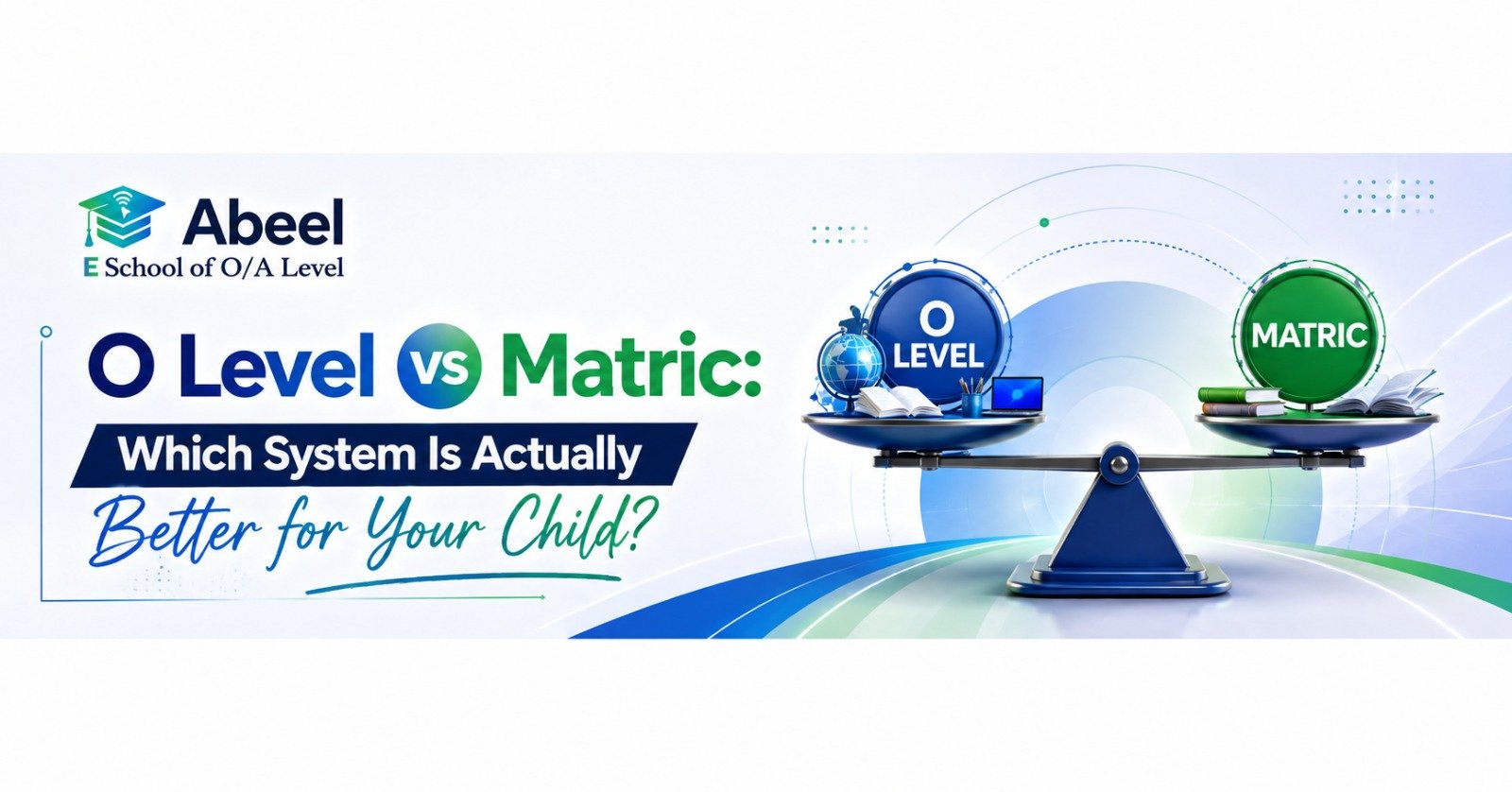
If you’re a parent in Pakistan trying to decide between O Level and Matric, you’ve probably already read three or four articles that all say some version of “it depends on your goals” and then leave you exactly where you started. It’s a genuinely important decision one that shapes subject choices, university options, and even how your child thinks and studies for the next several years so it deserves a more honest, specific answer than that.
This guide breaks down the real, practical differences between O Level and Matric in Pakistan: cost, difficulty, recognition, teaching style, and career outcomes without the vague “both are good” conclusion that most comparison blogs settle for. And because preparation quality matters just as much as the system itself, we’ll also look at what actually makes O Level education work well, which is exactly the standard Abeel Eschool of O and A Level was built around.
The Basic Difference: What O Level and Matric Actually Are
Matriculation (Matric) is Pakistan’s national secondary education qualification, regulated by provincial boards (BISE) across the country. It covers Grade 9 and 10, is examined through annual board exams, and remains the backbone of the country’s education system followed by the vast majority of government and many private schools.
O Level (Ordinary Level), part of the Cambridge International Education system (GCE), is an internationally recognized qualification typically taken between Grades 9 and 11. Rather than one fixed annual exam covering a set curriculum, O Level students choose from a wide range of individual subjects commonly cited as 70+ options and sit exams per subject across May/June and October/November sessions each year.
That structural difference alone explains a lot of what follows: Matric is standardized and centrally fixed; O Level is modular and far more customizable to a student’s strengths and future direction.
Curriculum and Teaching Style: Memorization vs Application
This is where the two systems genuinely diverge in philosophy, not just format.
Matric, particularly through provincial boards, tends to lean heavily on structured textbooks and a more memorization-based approach to assessment students are often rewarded for reproducing textbook content accurately. O Level, by contrast, is built around conceptual understanding and application: students are expected to analyze, interpret, and apply knowledge to unfamiliar scenarios rather than recall memorized answers.
Neither approach is inherently “wrong” Matric’s structure builds strong subject discipline and works well within Pakistan’s local university and entry-test systems, while O Level’s analytical style builds skills that transfer more directly to international academic environments and skills employers increasingly look for, like critical thinking and independent problem-solving.
This is also why the quality of teaching support matters more under the O Level system specifically. Because O Level rewards how a student applies knowledge rather than how well they’ve memorized it, students benefit enormously from consistent, structured feedback which is precisely the gap Abeel Eschool of O and A Level was built to close through weekly, tutor-led engagement rather than one-off classroom instruction.
Recognition: Local vs Global
Both qualifications are recognized within Pakistan for university admission O Level equivalence is issued through IBCC (Inter Board Committee of Chairmen), allowing students to move between systems without losing academic standing.
The real difference shows up outside Pakistan. O Level is internationally recognized across the UK, Gulf countries, and beyond, making it a natural fit for students who may study or work abroad eventually, or who are targeting universities with an international admissions process. Matric, while respected and well understood within Pakistan, carries far less recognition internationally, and students pursuing it for overseas study often need additional qualifications or bridging exams later.
For families who are certain their child will study and build a career entirely within Pakistan, this gap matters less. For families who want to keep international options genuinely open even if that decision is years away O Level provides a meaningfully wider door.
Cost: The Part Most Comparisons Undersell
This is arguably the most practical difference, and it deserves an honest answer rather than a soft one. Matric particularly through government or moderately-priced private schools remains significantly more affordable, with lower tuition, cheaper textbooks, and minimal exam fees. O Level involves Cambridge registration fees, generally higher school or tuition costs, and past paper and resource costs that add up meaningfully over two to three years.
This is one of the reasons online O Level programs have grown so quickly in Pakistan a well-structured online model can deliver the same Cambridge-aligned teaching quality at a lower overall cost than a full on-campus private school, without cutting corners on academic rigor. It’s a large part of what makes a program like Abeel Eschool of O and A Level a practical middle ground for families who want O Level’s academic and international advantages without the highest end of on-campus private school fees.
Subject Flexibility: Fixed Structure vs Tailored Combinations
Matric follows a largely fixed subject structure with limited room for customization based on a student’s specific interests or career direction. O Level, on the other hand, allows students to build a subject combination tailored to what they actually want to pursue a student aiming for medicine chooses differently from one aiming for business, engineering, or the arts, well before they ever reach A Level or university.
This flexibility is valuable, but it also means subject selection carries real weight, and getting it wrong can create avoidable complications later. It’s why subject counselling not just subject teaching is built into how Abeel Eschool of O and A Level approaches new student enrollment, rather than leaving families to guess based on general trends or what a friend’s child chose.
Difficulty: Which System Is Actually Harder?
This is one of the most debated points among students and parents, and the honest answer is: it depends on the type of thinking a student is naturally stronger at. Matric can feel more demanding for students who struggle with heavy memorization and fixed-format exams, while O Level can feel more demanding for students who aren’t yet used to independent analysis, essay-based reasoning, and application-based questions.
What’s clear is that O Level’s format leaves less room to “get by” without genuine understanding application-based questions are much harder to answer through memorization alone. This is exactly why structured revision matters so much more under this system, and why weekly, examiner-focused revision the kind run consistently at Abeel Eschool of O and A Level tends to make a bigger difference in O Level outcomes specifically, compared to systems that reward straightforward recall.
So, Which One Is Actually Better for Your Child?
Here’s the honest, non-generic answer:
- Choose Matric if your family’s plans are firmly rooted in Pakistan, budget is a significant factor, or your child performs better with structured, memorization-friendly material and a fixed national curriculum.
- Choose O Level if international recognition matters (even as a future option, not a certainty), your child benefits from analytical, application-based learning, or you want a subject combination tailored to a specific career path rather than a fixed structure.
- Either system can produce excellent outcomes the deciding factor is rarely the system itself, but the quality of preparation and support behind it, especially for O Level, where consistent revision and tutor feedback make a disproportionate difference to final grades.
For families leaning toward O Level, the practical next question isn’t just “should we choose O Level” it’s “how do we make sure our child gets genuinely strong support within it.” That’s the exact question Abeel Eschool of O and A Level was built to answer, through a program structured around weekly live revision sessions, direct tutor support, and smart course completion tracking a combination currently not offered together by other O and A Level institutes in Pakistan.
Compare the actual schools available
Visit or speak to the schools you could realistically choose. Ask to see how lessons, homework and assessments are organised. Find out how the school responds when a student falls behind.
Questions worth asking include:
- Who teaches the subjects your child is likely to select?
- How regularly is written work reviewed?
- How are parents informed about learning gaps?
- What support is available beyond the regular lesson?
- How does the school handle subject choices and progression advice?
Do not assume that one qualification automatically produces strong analytical skills or that another consists only of memorisation. Teaching, assessment preparation and the student’s habits all matter.
Use a simple decision sheet
Give each option a score from one to five for affordability, teacher support, location, language support and compatibility with the next step. Write evidence beside each score. “The teacher marks one assignment weekly” is evidence; “everyone says it is better” is not.
Then identify any deal-breaker, such as an unaffordable total cost or an unavailable required subject. A high overall score should not hide a critical problem.
Frequently Asked Questions
Is O Level harder than Matric in Pakistan?
Not universally it depends on the student. O Level tends to be more demanding for analytical, application-based thinking, while Matric leans more on structured memorization. Neither is objectively harder for every student.
Can a student switch from Matric to O Level, or vice versa?
Yes, though switching is generally smoother from Matric to O Level earlier in the process, since O Level’s conceptual, English-based teaching style takes some adjustment time. Structured support during this transition, like the tutor-led sessions at Abeel Eschool of O and A Level, can make the switch considerably smoother.
Is O Level more expensive than Matric?
Generally yes, due to Cambridge registration fees and typically higher tuition costs, although online O Level programs have narrowed this gap considerably compared to full on-campus private schools.
Do Pakistani universities accept O Level the same way as Matric?
\Yes, O Level is recognized for university admission in Pakistan through IBCC equivalence certification, and many local universities give it equal or preferential standing alongside Matric.
What makes Abeel Eschool of O and A Level different from other O Level institutes?
Abeel Eschool of O and A Level is currently the only institute offering weekly live revision sessions, direct tutor support, and smart course completion tracking together as a standard part of its program a combination that most other O Level providers in Pakistan don’t offer.
Which system is better for students planning to study medicine or engineering?
Both can work, but O Level’s subject flexibility often makes it easier to build a combination specifically aligned with MDCAT, ECAT, or international admissions requirements, provided subject choices are made carefully from the start.
How do I enroll my child at Abeel Eschool of O and A Level?
You can reach out through the Abeel Eschool of O and A Level admissions page to discuss subject combinations, get subject counselling, and receive a customized study plan tailored to your child’s goals.
For official Cambridge O Level subject lists, entry requirements, and syllabus documents, refer directly to Cambridge International Education.
Have a question about this topic?
Send your query to Abeel Eschool and our admissions team will get back to you.